

A US visa ban can directly delay or block an EB-5 investor’s ability to enter the United States, adjust their immigration status, or receive their green card, even when their petition has already been approved. Understanding how these bans intersect with the EB-5 program is critical for anyone pursuing a US green card through investment.
What Is the EB-5 Investor Visa Program?
The EB-5 program was created by Congress in 1990 to attract foreign capital into the US economy. In exchange for a qualifying investment, typically $1,050,000 nationally or $800,000 in a Targeted Employment Area, investors and their immediate families become eligible for permanent residency.
The investment must create or preserve at least 10 full-time jobs for US workers. Investors can either invest directly in a new commercial enterprise or route their capital through a USCIS-designated regional center.
Historically, investors from countries like China, India, Vietnam, and South Korea have dominated EB-5 filings, largely because of strong economic ties and high demand for a US green card through investment.
How Does a US Visa Ban Affect EB-5 Investors?
The US Visa Ban affect on EB-5 depends on the type and scope of the ban, and where the investor currently stands in the EB-5 process. A presidential proclamation or executive order restricting entry from a specific country or region can affect EB-5 investors in the following ways:
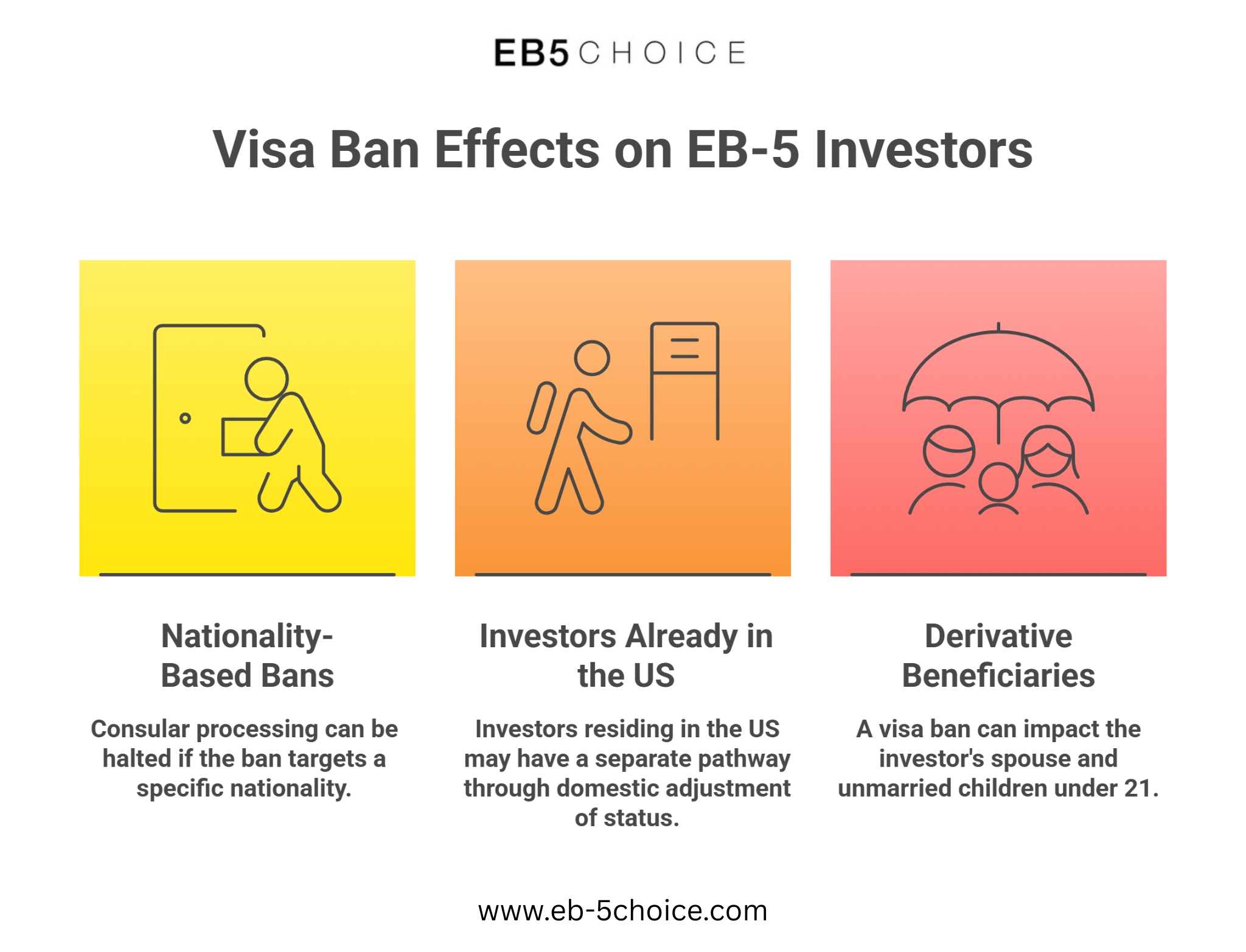
1. Nationality-Based Bans Can Halt Consular Processing
-
If a visa ban targets a specific nationality, an otherwise eligible investor may have their consulate interview cancelled or indefinitely postponed.
-
The underlying I-526 or I-526E petition remains approved and intact, but forward movement through the visa process effectively freezes.
-
During the COVID-19 pandemic, Presidential Proclamation 10014 suspended immigrant entry, including EB-5 applicants. Thousands of investors with approved petitions could not proceed to consular processing, sometimes for over a year.
2. Investors Already in the US Have a Separate Pathway
-
If an investor is residing in the US on a nonimmigrant visa, a travel or entry ban does not automatically block domestic adjustment of status through Form I-485.
-
This applies as long as a visa number is currently available.
-
The adjustment of status route is largely insulated from consular-side restrictions, which is why many investors choose to enter the US first and file from within the country.
Already in the US on a nonimmigrant visa? Discover how Concurrent Filing works and whether it can shield your EB-5 case
3. Derivative Beneficiaries Can Be Separately Affected
-
A visa ban can impact the investor’s spouse and unmarried children under 21, even if the principal investor is unaffected.
-
If a spouse holds a different nationality than the principal investor, they may face separate and distinct processing complications depending on how the ban is worded.
-
Each family member’s situation needs to be assessed individually, not assumed to follow the same path as the principal applicant.
Nationality-Based Backlogs vs. Visa Bans: An Important Distinction
One common source of confusion is mixing up visa retrogression with an actual visa ban. They are not the same thing, though both cause delays.
Visa retrogression means there are more approved petitions from a given country than there are visa numbers available in that fiscal year. China-born EB-5 investors, for example, have faced retrogression periods extending several years. This is a quota issue, not a ban.
A visa ban, by contrast, is a policy-driven restriction, often issued by executive authority, that can apply regardless of whether a visa number is available. A Chinese investor could theoretically have a current priority date and still be blocked from receiving a visa during an active ban period.
Already dealing with visa delays beyond a ban? Read our complete guide on Navigating Visa Backlogs for guidance.
Below is a simplified breakdown of how these two issues compare:
|
Factor
|
Visa Retrogression
|
Visa Ban
|
|
Cause
|
High demand, limited visa numbers
|
Executive or legislative policy
|
|
Affects I-526 approval?
|
No
|
No
|
|
Affects consular processing?
|
Yes, delays it
|
Yes, can halt it entirely
|
|
Affects adjustment of status?
|
Yes, delays filing
|
Generally no, if already in the US
|
|
Resolution timeline
|
Depends on annual visa allocation
|
Depends on policy reversal or court action
|
|
Investor’s investment at risk?
|
No, legally protected
|
No, but delays extend
|
Key Challenges EB-5 Investors Face During a Visa Ban
Extended Capital Lock-In
EB-5 investments are not liquid. Once capital is placed into a project or regional center, it is typically tied up for the duration of the immigration process. A visa ban extends that timeline without any corresponding adjustment to the investment structure.
Investors who budgeted for a three to four year process may find themselves locked in for six years or more.
Retrogression could be adding years to your wait- not just the ban. Understand how EB-5 retrogression works and what it means for your capital lock-in period.
Job Creation Deadlines
USCIS requires that the 10-job creation requirement be met by the time the investor files to remove conditions on their residency (Form I-829). If visa delays push back the entire timeline, job creation evidence must still be maintained and documented over a longer period. Regional centers and project developers face added pressure to keep records current.
Children Aging Out
This is one of the most emotionally difficult consequences of prolonged delays. A child who was under 21 when the I-526 was filed may turn 21 before the visa is issued, potentially losing derivative beneficiary status.
The Child Status Protection Act offers some relief, but it does not fully protect against aging out when visa bans cause significant delays.
Uncertainty Around Redeployment
When funds sit in a regional center project longer than intended due to visa delays, some projects redeploy capital into secondary investments. The rules around redeployment have evolved, and investors need to understand whether their agreement permits this and whether redeployed funds still satisfy USCIS requirements.
Practical Guidance for Navigating These Risks
Working with an experienced EB-5 visa consultant is arguably the most important step an investor can take before and during this process. Not all immigration attorneys specialize in EB-5 specifically, and the nuances of visa bans, redeployment clauses, and adjustment of status strategy are areas where specialist knowledge makes a real difference.
When evaluating best EB-5 projects, investors should look specifically at projects with extended job creation periods, flexible deployment structures, and legal agreements that account for timeline uncertainty. A project developer who has navigated prior visa suspension periods is worth prioritizing over one with a shorter track record.
For investors eligible to enter the US before their immigrant visa is processed, adjusting status from within the country avoids the consular processing pathway entirely and provides some insulation from travel ban disruptions.
It is also worth noting that an investment made in a Targeted Employment Area, carries the lower $800,000 threshold and has historically been associated with regional center projects in rural or high-unemployment zones. These projects sometimes have structural benefits for investors concerned about timeline risk, as they may offer more conservative job creation buffers.
FAQ Section: US Visa Ban Affects On EB-5 Investors
Can a visa ban cancel my approved EB-5 petition?
No. A visa ban does not revoke or cancel an approved Form I-526 or I-526E petition. Approval of the petition is a separate determination made by USCIS and is unaffected by consular or entry-related restrictions.
What a ban can do is prevent you from proceeding to the next step, which is visa issuance or adjustment of status, for the duration of the restriction.
If I am already in the US on a work or student visa, does a visa ban affect my EB-5 process?
Generally, if you are in lawful nonimmigrant status in the US and a visa number is available, you can still file Form I-485 to adjust status domestically. Visa bans typically affect consular processing and physical entry, not domestic adjustment filings.
However, travel outside the US during a ban period could create re-entry problems, so advance parole considerations become very important.
How have previous US visa bans impacted EB-5 processing historically?
The most significant recent example was the immigrant visa suspension issued in April 2020, which halted EB-5 consular interviews globally for several months. Combined with consulate closures, this effectively froze a large portion of overseas EB-5 cases for over a year. Some investors used this period to pursue adjustment of status if they were already in the country, while others faced extended waits abroad.
Does a visa ban affect my family members differently?
Yes, it can. Derivative beneficiaries, meaning a spouse or children, are processed alongside the principal investor but may face different complications depending on their individual nationality or location. In cases where family members are in different countries or hold different passports, each person’s processing pathway needs to be assessed separately. This is a detail that often gets overlooked until it becomes a problem.
What should I do right now if a visa ban is affecting my EB-5 case?
First, confirm with your immigration attorney whether your case qualifies for adjustment of status as an alternative to consular processing. Second, review your investment agreement for provisions related to timeline extensions or redeployment. Third, track your children’s ages carefully relative to your priority date. Finally, request a case status update from your regional center or project manager to understand whether job creation remains on track.
Conclusion
A visa ban does not erase an EB-5 investor’s petition, their invested capital, or their path to residency. But it can compress timelines, strand families in holding patterns, and introduce risks that were not part of the original plan.
The investors who navigate this best tend to be the ones who understood the risk landscape before they committed capital, chose projects and advisors carefully, and maintained flexibility in their immigration strategy. The EB-5 program has survived multiple policy disruptions over its history. Investors who go in informed tend to come out the other side intact.