


If you are weighing the option of switching from an EB-2 visa to EB-5 visa, the short answer is this: the EB-5 program offers a faster path to a U.S. green card for those who can make a qualifying investment, while the EB-2 route rewards advanced degrees or exceptional ability but can involve multi-year wait times for applicants from high-demand countries like India and China. Understanding the distinctions, costs, processing timelines, and strategic trade-offs between these two categories is essential before making any decision.
This guide explains how the transition works, eligibility considerations, financial requirements, timelines, risks, and strategic planning factors for professionals considering this pathway.
Understanding the EB-2 and EB-5 Immigration Categories
The U.S. employment-based immigration system is divided into preference categories, each targeting a different profile of immigrant. The EB-2 category is designed for professionals holding advanced degrees or individuals with exceptional ability in the sciences, arts, or business. It also includes the National Interest Waiver (NIW) subcategory, which allows eligible applicants to self-petition without a job offer if their work benefits the United States broadly.
The EB-5 Immigrant Investor Program, administered by U.S. Citizenship and Immigration Services (USCIS), was created by Congress in 1990 with a specific purpose: to stimulate the U.S. economy through job creation and capital investment.
Foreign nationals who invest a qualifying amount of capital in a U.S. commercial enterprise that creates at least 10 full-time jobs for U.S. workers become eligible for lawful permanent residence through this route.
Both categories lead to a green card, but they operate through entirely different mechanisms, timelines, and financial requirements. Choosing the right one depends on your country of birth, professional background, financial capacity, and urgency.
Why Would Someone Switch from EB-2 Visa to EB-5 Visa?
The primary driver pushing applicants toward EB-5 is the green card backlog. For nationals of India and China, the EB-2 wait time has stretched to decades in some cases.
The U.S. Department of State Visa Bulletin has shown that EB-2 India priority dates have remained stuck for years, with some estimates placing the wait at 50 years or longer at current processing rates. (source)
Faced with that reality, many skilled professionals from oversubscribed countries turn to EB-5 as a practical alternative.
For applicants from countries without significant backlogs, such as Brazil, South Korea, or the United Kingdom, EB-2 may move fairly quickly. But for those caught in the retrogression trap, like India, China or Vietnam, the EB-5 pathway offers current or near-current visa availability in most cases, particularly through the Rural and High Unemployment set-aside categories created under the EB-5 Reform and Integrity Act of 2022.
Another scenario involves applicants who no longer meet EB-2 criteria, such as those who have changed careers or whose employer-sponsored petition has lapsed.
EB-5 removes the employer dependency entirely. There is no job offer, no Labor Condition Application, and no employer-sponsored petition. The investor controls the immigration process independently.
EB-5 Investment Requirements: What You Need to Know
The minimum investment thresholds for EB-5 are set by USCIS and were last adjusted in 2022. Two tiers apply depending on project location:
-
Standard minimum: $1,050,000 in a Targeted Employment Area (TEA)
-
Reduced minimum: $800,000 if the project is in a rural or high-unemployment area
These amounts are adjusted periodically for inflation, so confirming current figures directly with USCIS before proceeding is always advisable.
Most applicants invest through USCIS-designated Regional Centers, which pool capital from multiple investors and deploy it into large commercial projects. Popular project types include:
-
Hotels and hospitality developments
-
Mixed-use real estate
-
Hospitals and healthcare facilities
-
Infrastructure projects
Regional Center investments are popular because they allow passive participation. The investor does not need to manage the business directly, and job creation can be counted indirectly through economic modeling, making it easier to satisfy the 10-job requirement.
Working with a qualified EB-5 investment advisor is one of the most critical steps in this process. The EB-5 landscape includes hundreds of Regional Center projects with varying risk profiles, and an experienced advisor will assess:
-
I-924 approval status of the project
-
Escrow protections and capital security arrangements
-
Developer background and track record
-
Exit strategy and repayment timeline
Thorough vetting at this stage significantly reduces both financial and immigration risk before you commit capital.
Most applicants invest through USCIS-designated Regional Centers, which allow passive participation and indirect job creation. Find out why EB-5 investors choose Regional Centers over direct investments.
EB-2 vs EB-5: Side-by-Side Comparison
|
Factor |
EB-2 Visa |
EB-5 Visa |
|
Basis |
Advanced degree or exceptional ability |
Capital investment ($800K–$1.05M+) |
|
Job Offer Required |
Usually yes (NIW is an exception) |
No |
|
Processing Time (No Backlog) |
12–24 months |
24–48 months (varies) |
|
Backlog (India/China) |
Decades for some categories |
Faster via Rural/High-Unemployment set-asides |
|
Self-Petition Option |
Only via NIW |
Yes — investor petitions independently |
|
Financial Requirement |
Minimal (attorney + filing fees) |
Minimum $800,000 investment |
|
Job Creation Requirement |
None |
10 full-time U.S. jobs |
|
Green Card Type |
Permanent (employment-based) |
Conditional, then permanent |
|
Employer Dependency |
High (most subcategories) |
None |
How to Evaluate the EB-5 Projects
Not all Regional Center projects carry equal merit, and selecting the wrong one can result in both financial loss and immigration failure. The best EB-5 projects share several consistent characteristics:
-
they are located in USCIS-designated TEAs,
-
they have received I-924 exemplar approval, and
-
they come with transparent job creation methodologies supported by third-party economic impact studies.
Beyond the regulatory checkboxes, strong projects have experienced development sponsors with a demonstrable history of completing comparable real estate or infrastructure projects.
They offer clear repayment timelines and collateral structures, and they operate in sectors with stable economic demand, such as healthcare facilities, affordable housing, and logistics infrastructure.
Investors should review the Private Placement Memorandum (PPM) and subscription agreement carefully. These documents outline material risks including construction delays, changes in immigration policy, and the possibility of capital loss.
The EB-5 program does not guarantee returns or immigration approval, and USCIS adjudicates the immigration petition independently of the investment outcome.
Selecting the wrong Regional Center can result in both financial loss and immigration failure. Check our guide on how to evaluate an EB-5 Regional Center before investing.
What Should You Expect in Terms of Return on Investment in EB-5 ?
The EB-5 program is primarily an immigration vehicle, not a wealth-building strategy, and applicants should calibrate their expectations accordingly. The EB-5 return on investment has historically been modest, typically ranging from 0.5% to 3% per year for Regional Center investments, though some projects have returned principal plus a small interest payment at the end of the investment period.
The investment horizon is significant. Most EB-5 investors are required to keep their capital at risk for the duration of the green card process, which can span five to seven years or longer depending on USCIS processing timelines and any Request for Evidence (RFE) responses required.
Unlike traditional venture investment, the primary return for most EB-5 investors is not financial but rather the immigration outcome itself. That said, investors should not accept unnecessarily unfavorable terms and should compare multiple projects with the guidance.
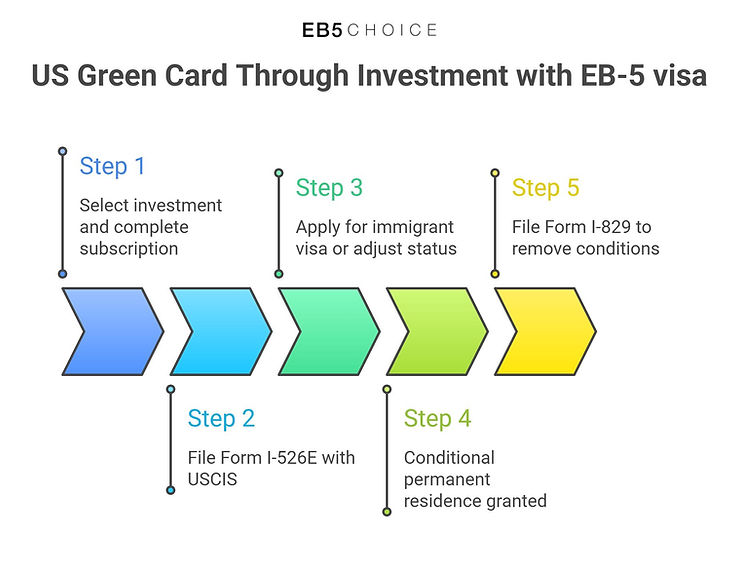
The Path to a US Green Card Through Investment with EB-5 visa
The process of obtaining a US green card through investment involves several sequential stages, each with its own documentation requirements and processing timelines.
-
Step 1: Select a qualifying Regional Center project or direct investment opportunity and complete the subscription. Capital is typically placed into an escrow account pending I-526E approval.
-
Step 2: File Form I-526E, the Immigrant Petition by Regional Center Investor, with USCIS. This petition establishes that the investment meets program requirements and that the investor is the lawful source of funds. USCIS processing times for I-526E petitions have ranged widely, with recent reports indicating timelines between 18 and 36 months.
-
Step 3: Upon I-526E approval, if a visa number is immediately available, the investor and qualifying family members (spouse and unmarried children under 21) either apply for an immigrant visa at a U.S. consulate abroad or file Form I-485 to adjust status if already in the United States lawfully.
-
Step 4: Conditional permanent residence is granted for a two-year period. During this time, the investment must remain at risk and the job creation requirement must be documented.
-
Step 5: Within the 90-day window before the conditional green card expires, the investor files Form I-829 to remove conditions. Approval of I-829 grants unconditional permanent residence, completing the green card process.
Key Challenges and Considerations When Switching Pathways
Switching from EB-2 to EB-5 is not simply a matter of submitting a new petition. Applicants who are currently in H-1B or other nonimmigrant status must maintain valid status throughout the EB-5 process.
The EB-2 petition does not need to be formally withdrawn, and in some cases maintaining a parallel EB-2 petition as a fallback strategy while pursuing EB-5 is a viable approach.
Source of funds documentation is a critical and often underestimated component of the EB-5 process. USCIS requires a complete paper trail showing that the investment capital was lawfully obtained. This includes tax returns, bank statements, business ownership documents, gift letters if applicable, and wire transfer records. Gaps or inconsistencies in this documentation are a leading cause of Requests for Evidence and petition denials.
Applicants should also be aware of the retrogression risk within EB-5 itself. If the Rural and High Unemployment set-aside categories become oversubscribed, wait times for investors from high-demand countries could extend significantly. Monitoring the Visa Bulletin regularly and working with advisors who track annual usage patterns is essential for managing this risk.
Source of funds documentation is a critical and often underestimated component of the EB-5 process. See exactly what USCIS requires for source of funds documentation of EB-5.
Practical Steps for Making the Switch
-
Consult an experienced EB-5 immigration attorney before withdrawing or abandoning any existing EB-2 petition. Parallel pathways are often possible and strategically advantageous.
-
Engage a qualified eb5 investment advisor to evaluate Regional Center projects. Focus on projects with USCIS exemplar approval, strong developer track records, and transparent exit structures.
-
Prepare source of funds documentation early. This is the most document-intensive part of the I-526E petition and often the most time-consuming to assemble.
-
Monitor USCIS processing times and Visa Bulletin updates monthly. Immigration timelines shift, and proactive tracking helps you plan dependent milestones like employment authorization and travel permits.
-
If you are in H-1B or another nonimmigrant status, ensure your employer is aware of your EB-5 pursuit and that your current status remains valid. EB-5 does not provide independent work authorization until the green card or EAD is issued.
Frequently Asked Questions: EB-2 Visa to EB-5 Visa
Can I pursue EB-2 and EB-5 at the same time?
Yes. There is no USCIS rule preventing an applicant from maintaining concurrent employment-based petitions. Many skilled professionals from high-backlog countries file an I-526E for EB-5 while keeping an active EB-2 petition as a contingency.
If EB-5 is approved and a visa becomes available first, the investor can proceed through that pathway without the EB-2 petition being a barrier. Your attorney should be informed of both petitions to coordinate the strategy properly.
How long does the full EB-5 process take from start to green card?
The timeline varies based on your country of birth and USCIS processing speed at the time of filing. For applicants from countries without significant visa backlogs, the process from I-526E filing to conditional green card approval has ranged from three to six years in recent cycles.
Nationals from Mainland China have faced longer waits historically due to high demand, though the Rural and High Unemployment set-aside categories created under the 2022 Act have provided some relief with faster visa availability.
Is my investment guaranteed to be returned in EB-5?
No. The EB-5 program requires that capital be placed at risk, meaning there is genuine exposure to the commercial enterprise. USCIS specifically prohibits guaranteed return arrangements because they would undermine the lawful at-risk requirement.
Investors may receive capital back plus modest interest upon project completion and I-829 approval, but this depends on the financial performance of the underlying project. Due diligence and project selection significantly influence financial outcomes.
What happens to my EB-5 petition if the Regional Center is terminated by USCIS?
The EB-5 Reform and Integrity Act of 2022 introduced investor protections that allow investors whose Regional Center is terminated or whose I-526E is affected by a project material change to refile without losing their original priority date, under certain conditions.
This protection is significant because it reduces the risk of losing years of waiting time due to factors outside the investor’s control. Your immigration attorney should monitor your Regional Center’s standing with USCIS proactively throughout the process.
Does EB-5 include my spouse and children?
Yes. A successful EB-5 petition covers the principal investor, their spouse, and any unmarried children under the age of 21 at the time of filing. All qualifying family members receive conditional permanent residence at the same time as the investor and are included in the I-829 petition to remove conditions.
Children who turn 21 during the process may be protected from aging out under the Child Status Protection Act in certain circumstances, which is another reason to file as early as possible.
Conclusion
The decision to switch from an EB-2 visa to EB-5 visa is one that requires careful analysis of your personal financial position, your country of birth, your current immigration status, and your timeline for achieving permanent residence. For many applicants trapped in decade-long EB-2 backlogs, EB-5 represents a practical and legally sound path to a U.S. green card that does not require employer sponsorship and can move substantially faster under current visa availability conditions.
The investment is substantial and the process is complex, but with the right legal counsel, a rigorously vetted Regional Center project, and thorough documentation of source of funds, the EB-5 pathway has delivered green cards for thousands of investors and their families. Assess your situation, consult qualified professionals, and make the decision with full information.