


The EB-5 visa bulletin for March 2026 release from the U.S. Department of State shows incremental but meaningful movement in the EB-5 immigrant investor category, with final action dates advancing in several oversubscribed countries and chart B dates offering a broader window for filing adjustment of status applications.
For foreign investors waiting to secure a green card, understanding how to read these charts and what the current movement means for your timeline is not optional. It is the foundation of every strategic decision you will make in your immigration journey this year.
This post breaks down the March 2026 bulletin in practical terms, explains what the date movements mean for EB-5 investors specifically, and offers actionable guidance on next steps regardless of where you are in the process.
What Is the Visa Bulletin and Why Does It Matter for EB-5 Investors?
The Visa Bulletin is a monthly update from the U.S. Department of State that determines when immigrant visa applicants can move forward in the green card process. It includes two charts: Final Action Dates, which show when a visa can be issued, and Dates for Filing, which indicate when applicants can submit adjustment of status paperwork earlier. (source)
For investors in the EB-5 Immigrant Investor Program, the bulletin is critical because demand from countries such as China, India, Vietnam, and South Korea often exceeds the annual visa supply. The program has a 7 percent per-country cap within the roughly 10,000 EB-5 visas issued each year, which can create backlogs.
An investor’s priority date is the date their I-526 or I-526E petition was filed. If the priority date is earlier than the cutoff date in the bulletin, the visa is current and the investor can proceed. If it is later, the applicant must wait until the dates advance.
What Does the Visa Bulletin for March 2026 Show for EB-5 Categories?
The visa bulletin March 2026 reflects the ongoing two-track system created by the EB-5 Reform and Integrity Act of 2022, which introduced the Rural, High Unemployment Area, and Infrastructure set-aside categories.
These set-asides receive a portion of the annual EB-5 allocation independent of the general pool, which has created meaningfully different priority date scenarios depending on which category an investor filed under.
Here is what the March 2026 bulletin reflects across the main categories:
|
Category |
China (Mainland) |
India / Vietnam |
All Other Countries |
|
EB-5 General (C5, T5, I5, R5) |
Retrogressed / Priority date required |
Current or near-current |
Current |
|
EB-5 Rural Set-Aside |
Priority date advancing; backlog forming |
Current |
Current |
|
EB-5 High Unemployment Area |
Retrogressed; slower movement |
Current or slight backlog |
Current |
|
EB-5 Infrastructure |
Priority date required; limited backlog |
Current |
Current |
Note: This table reflects patterns visible in the March 2026 bulletin and is intended for informational context only. Priority dates shift monthly.
How the EB-5 Reform Act Changed the Bulletin’s Meaning for Investors
The EB-5 Reform and Integrity Act of 2022 introduced separate visa allocations within the EB-5 Immigrant Investor Program:
-
20 percent for rural projects,
-
10 percent for high-unemployment areas, and
-
2 percent for infrastructure, with the rest remaining in the general pool.
Since 2022, this structure has created different visa timelines. Rural and infrastructure projects have generally moved faster because demand has not yet matched their dedicated visa supply.
Meanwhile, the general pool has become more competitive, particularly for Chinese investors. Data from U.S. Citizenship and Immigration Services shows China-born applicants have historically accounted for a large share of EB-5 petitions, which is why China’s cutoff dates are closely watched.
As a result, project category selection now directly affects visa timelines, and choosing between rural and urban projects can mean years of difference in waiting time.
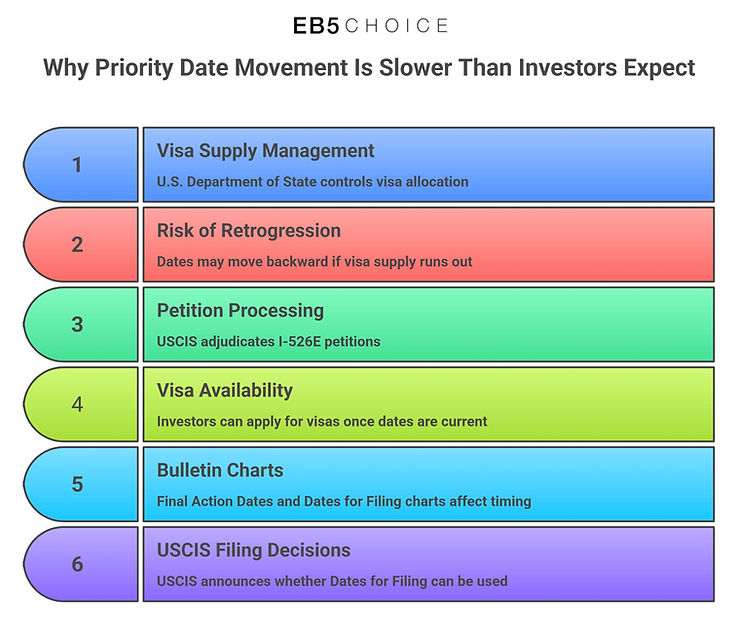
Why Priority Date Movement Is Slower Than Investors Expect
A common source of frustration is that even when the bulletin shows forward movement, the practical effect on individual timelines can feel negligible. Several factors explain this dynamic.
-
Visa supply must be carefully managed. The U.S. Department of State controls how quickly priority dates advance to avoid using up the annual visa allocation before the fiscal year ends on September 30.
-
Risk of retrogression. If dates move forward too quickly and the visa supply runs out, retrogression can occur, meaning a previously current priority date becomes unavailable again.
-
Petition processing times still matter. Even if a priority date becomes current, an investor cannot proceed until their I-526E petition is adjudicated by U.S. Citizenship and Immigration Services, which has historically taken 12 to 48 months depending on the period.
-
Visa availability is only one step. Investors with a current priority date but a pending petition may not see immediate progress.
-
Two different bulletin charts affect timing. The Final Action Dates chart determines when a visa can be issued, while the Dates for Filing chart indicates when investors can submit adjustment of status paperwork earlier.
-
Monthly USCIS filing decisions matter. Each month, USCIS announces whether applicants can use the Dates for Filing chart, which can allow investors to apply sooner and access interim benefits like work authorization and travel documents.
How Working with EB-5 Visa Consultants Shapes Your Response to the Bulletin
Experienced EB-5 visa consultants interpret each bulletin in the context of an individual investor’s specific filing date, country of birth, project category, and USCIS case status.
What looks like a favorable movement on paper may be irrelevant for someone whose petition was filed after the current cutoff, while the same movement could be transformative for an investor who filed years earlier and is just crossing the threshold.
Good advisory in this space involves scenario modeling, which includes:
-
Projecting how quickly dates may move based on historical patterns
-
Analyzing total demand visible in I-526E receipt data
-
Assessing USCIS’s current processing velocity
Investors who rely on general summaries rather than tailored analysis often miss filing windows that could have accelerated their timeline by six to twelve months.
It is also worth noting that the bulletin affects investors’ dependent family members. Spouses and unmarried children under 21 who are included in the petition are subject to the same priority date cutoffs.
Families with children nearing the age cutoff have an acute interest in:
-
Tracking date movement closely
-
Understanding when to file concurrently
This adds another layer of complexity that benefits significantly from expert guidance.
Does Project Selection Still Matter After Filing?
Choosing among the best EB-5 projects was once primarily a financial underwriting exercise. Today, the project category has direct implications for visa bulletin positioning.
The answer depends on the specific circumstances, but generally, investors cannot retroactively change their project category once an I-526E is approved. An investor who filed under the general pool remains in the general pool, regardless of where dates have moved in rural or infrastructure lanes.
This makes pre-filing category selection one of the highest-stakes decisions in the entire EB-5 process. Project evaluation must now incorporate immigration timeline analysis alongside traditional financial due diligence metrics, including:
-
Job creation documentation
-
Capital structure
-
Regional center track record
For prospective investors reviewing the March 2026 Bulletin, the key question is no longer just which project has the strongest financial profile– it is which project category aligns with their personal visa timeline requirements.
The bulletin makes those constraints concrete and quantifiable. Consider how differently the following investors must approach category selection:
-
An investor with a child approaching 21: faces strict, time-sensitive constraints driven by the age-out risk, leaving little room for error in category choice.
-
A single applicant with no timeline urgency: has far greater flexibility and can prioritize financial strength over speed of visa processing.
What the March 2026 Bulletin Means for Your Green Card Timeline
Obtaining a green card for investors in the US through EB-5 is a multi-year process under normal conditions, and the bulletin is the mechanism that determines whether your timeline is measured in months or years beyond those baseline processing expectations.
For investors from non-backlogged countries, the current bulletin is relatively straightforward.
Final action dates are current or near-current across all EB-5 categories, which means the primary variable is USCIS petition processing time rather than visa availability.
-
Final action dates are current or near-current for all EB-5 categories
-
The key bottleneck is USCIS petition processing time, not visa availability
-
Once an I-526E is approved, investors can move quickly through the consular process or adjustment of status
-
Path depends on whether the investor is inside or outside the United States
For Chinese nationals, the situation is significantly more complex. Final action dates in the general pool have historically lagged by years, and investors in oversubscribed categories face waits that can extend well beyond a decade in worst-case scenarios.
-
General pool final action dates have historically lagged by years
-
Worst-case wait times in the general pool can exceed a decade
-
Set-aside categories offer some relief, but primarily benefit investors in rural projects
-
Many Chinese investors now focus specifically on rural set-aside projects, where dedicated visa allocation has kept dates more current.
The Supply Demand Gap
-
Annual EB-5 visa allocation sits at approximately 10,000 visas per year. (source)
-
USCIS has had over 20,000 pending I-526 and I-526E petitions at various points in recent history
-
The gap between supply and demand is the core driver of priority date backlogs
-
Understanding this gap helps investors set realistic expectations rather than relying on optimistic projections
The Path from EB-5 Visa to Citizenship: What Investors Should Know
The journey from EB-5 visa to citizenship begins once an investor in the EB-5 Immigrant Investor Program receives a conditional green card. This starts a two-year conditional residency period during which the investor must maintain their investment and meet the required job creation goals.
At the end of this period, they file Form I-829 with U.S. Citizenship and Immigration Services to remove conditions.
After becoming a permanent resident, the investor must meet naturalization requirements, including five years of lawful permanent residence, 30 months of physical presence in the United States, and passing the civics and English tests.
For most investors, the EB-5 citizenship timeline typically ranges from seven to ten years, and it may take longer for applicants from countries facing visa backlogs.
Practical Steps to Take Based on the March 2026 Bulletin
Regardless of where you are in the EB-5 process, the March 2026 bulletin suggests several concrete actions worth evaluating:
-
Confirm your priority date and identify your exact position relative to both the Final Action Dates and the Dates for Filing charts. These are not the same thing, and confusing them leads to missed filing opportunities.
-
If you are pre-filing and evaluating projects, prioritize understanding which category your project falls under and model visa timelines for your country of birth across rural, high unemployment, and general-pool categories before committing capital.
-
If your case is pending and your priority date is approaching currency, begin preparing adjustment of status documents or consular processing materials now. USCIS recommends having documentation ready in advance, and delays in document preparation are avoidable causes of timeline extension.
-
Track the USCIS announcement each month about which filing chart it will honor. This announcement typically comes within the first two weeks of each month and determines whether Dates for Filing chart applicants can file that month.
-
If you have dependents approaching age 21, consult with immigration counsel immediately to understand how the Child Status Protection Act may or may not apply to your case, as the bulletin’s movement directly affects the age-out risk calculation.
Frequently Asked Questions- EB-5 Visa Bulletin March 2026
What is the difference between the Final Action Dates chart and the Dates for Filing chart in the EB-5 visa bulletin?
The Final Action Dates chart shows when an immigrant visa is actually available and a green card can be issued. The Dates for Filing chart shows when an applicant can submit adjustment of status paperwork before a visa is technically available.
USCIS announces each month whether it will accept filings from the Dates for Filing chart, and doing so allows investors to access interim benefits like work authorization and advance parole while waiting for their final green card.
How often do EB-5 priority dates move forward in the visa bulletin?
Priority dates move monthly as the State Department manages the annual visa supply across all preference categories and countries. Movement is not linear or predictable. Some months see meaningful advancement, others show no movement, and retrogression can pull dates backward if demand has been underestimated.
Historical patterns provide a general guide, but investors should not make binding decisions based on assumptions about future movement without current data from qualified advisors.
Do EB-5 set-aside categories have separate priority date tracking in the visa bulletin?
Yes. Since the EB-5 Reform and Integrity Act of 2022, the visa bulletin tracks rural, high unemployment area, and infrastructure set-aside categories separately from the general EB-5 pool.
Each set-aside category has its own annual visa allocation and, therefore, its own priority date cutoffs by country. Investors who filed under a set-aside category must track the bulletin row specific to their category rather than the general EB-5 line, as the dates can differ substantially.
Can an investor change their EB-5 project category after filing to benefit from faster priority date movement?
Generally, no. Once an I-526E petition is filed and approved, the project category is fixed. Investors cannot retroactively move to a set-aside category to benefit from faster date movement.
This makes upfront project and category selection one of the most consequential decisions in the EB-5 process, and it underscores why immigration timeline analysis must be part of the initial project evaluation, not an afterthought.
What happens if the visa bulletin retrogresses after I have already filed for adjustment of status?
If a retrogression occurs after an adjustment of status application has already been filed and accepted by USCIS, the application remains on file. The investor retains the ability to work and travel using the interim benefits associated with a pending adjustment application.
USCIS will simply not adjudicate the final green card until the priority date becomes current again. Retrogression after filing is disruptive but does not undo the progress made or eliminate interim protections.
Conclusion
The visa bulletin March 2026 is not just a government document. For EB-5 investors, it is a live signal about the state of one of the most complex and high-stakes immigration pathways available. Every chart update reflects real supply and demand dynamics that affect real timelines for real people who have invested significant capital in the expectation of building a life in the United States.
Understanding what the bulletin says, what it implies about near-term movement, and how it intersects with your specific filing status, country of birth, and project category is the foundation of a sound EB-5 strategy. Investors who treat monthly bulletin releases as background noise are the same investors who miss filing windows, fail to prepare documents on time, and absorb delays that could have been avoided.
Whether you are evaluating projects for the first time, waiting on a pending petition, or approaching a filing threshold, the March 2026 bulletin gives you concrete data to work with. Use it actively, review it alongside qualified counsel, and let it inform decisions rather than simply confirm assumptions. In a process where timing is everything, the bulletin is the closest thing to a real-time map.